Core Concepts
This page introduces the key concepts that form the foundation of the Agritech Java Application. Understanding these concepts will help you navigate the system, extend its functionality, and use it effectively.
1. Modular Architecture
The Agritech Java Application is built on a modular architecture to ensure scalability, maintainability, and separation of concerns. Each module focuses on a specific domain, such as:
- Crop Management: Manages crop lifecycle data, health monitoring, and yield predictions.
- Resource Management: Handles inventory, equipment, and resource usage.
- Supply Chain: Tracks produce from farm to market.
- User Management: Manages farmers, agribusinesses, and other stakeholders.
Each service communicates via REST APIs and Apache Pulsar for event-driven workflows.
2. Domain-Driven Design (DDD)
The application follows the principles of Domain-Driven Design (DDD) to ensure the code reflects the real-world agricultural processes it models. Key aspects include:
- Entities: Represent core objects such as
Crop,Field,Farmer, andOrder. - Aggregates: Group related entities and ensure business logic consistency.
- Repositories: Abstract database interactions for domain objects.
- Bounded Contexts: Ensure each module focuses on a specific business domain.
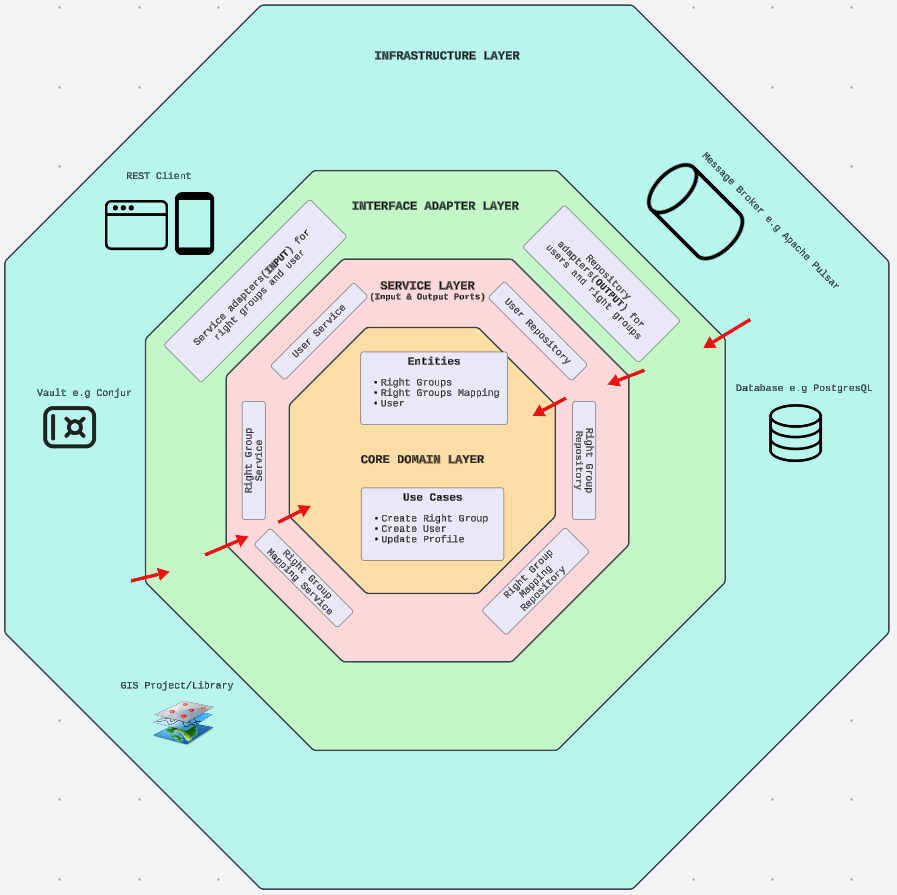
3. Hexagonal Architecture
Hexagonal Architecture, also known as the Ports and Adapters Architecture, is a design pattern that promotes a clear separation between the core business logic of an application and its external dependencies. This approach ensures that the core application is not tightly coupled to frameworks, databases, user interfaces, or other external systems.
Core Principles
- Separation of Concerns: The application is divided into distinct layers
- Domain/Core: The core business logic and rules reside here. This layer is framework-agnostic and does not depend on external systems.
- Ports: Interfaces that define how external systems interact with the application. These can include service interfaces, repository interfaces, or any other means of communication.
- Adapters: Implementations of the ports that handle the interaction with external systems such as databases, APIs, or user interfaces.
- Independence: The core domain logic remains isolated from technical details. This enables flexibility to swap out external dependencies (e.g., databases, frameworks) with minimal impact.
- Testability: The separation of business logic and external concerns makes the core easier to test in isolation.
This architecture enables changes in external systems without affecting the core logic, encourages clean and maintainable code with well-defined boundaries, future-proofs the application by minimizing dependencies on specific frameworks or technologies and simplifies unit and integration testing by isolating business logic from external systems.
4. Event-Driven Architecture
To handle asynchronous processes and decouple components and modules, the system uses Apache Pulsar as the messaging backbone. Examples include:
- Crop status updates trigger resource adjustments.
- Supply chain updates notify stakeholders in real-time.
- New farmer registration triggers farmer on-boarding automated steps
This approach ensures scalability and resilience across distributed components.
5. Spring Boot and Dependency Injection
The application leverages Spring Boot for rapid development and Spring's Dependency Injection to manage beans and application contexts. Commonly used components include:
- Spring Data JPA: Simplifies database operations.
- Spring Security: Provides role-based access control.
- Spring Cloud: Enables service discovery and centralized configuration.
6. API-First Design
All modules expose well-documented REST APIs to allow seamless integration with external systems. Key characteristics of the API design include:
- Consistency: Uniform endpoint naming and HTTP methods.
- Validation: Input is validated using Spring's
@Validannotations. - Error Handling: Custom error responses for better debugging.
- Authentication: JWT tokens for secure API access.
7. Caching for Performance
To ensure high performance and reduce latency, the system uses Redis for caching frequently accessed data. Examples include:
- JWT Data: Caching with expiry the JWT with user details to avoid hitting the main database to fetch the JWT's user.
- Crop Data: Cached for quick access in monitoring dashboards.
- Weather Data: Cached for faster lookup by users.
Caching also helps reduce database load during peak usage.
8. Data Persistence and Change Tracking
The system uses PostgreSQL as the primary relational database. Key practices include:
- Auditing: Tracks changes to important entities like crops and orders.
- Data Indexing: Ensures fast query performance for large datasets.
9. Security and Access Control
Security is paramount in the Agritech Java Application. Key features include:
- Rights-Based Access Control (RBAC): Users are assigned right groups with rights such as CREATE_USER, ADD_CROP and UPDATE_SOIL TEST.
- Encryption: Sensitive data is encrypted both in transit (via HTTPS) and at rest.
- Token-Based Authentication: Uses JWT for secure and stateless authentication.
10. Scalability and Deployment
The application is designed to scale efficiently with the following practices:
- Docker: For containerization and orchestration.
- Load Balancing: Ensures even distribution of traffic across services.
- Horizontal Scaling: Add more instances to handle increased workload.
11. Monitoring and Observability
To ensure reliability, the system integrates tools for monitoring and logging:
- Prometheus & Grafana: For performance monitoring and visualization.
- ELK Stack (Elasticsearch, Logstash, Kibana): For centralized logging and troubleshooting.
- Spring Actuator: Provides health checks and application metrics.
12. Common Design Patterns
The application employs well-established design patterns, including:
- Builder Pattern: For creating complex domain objects.
- Factory Pattern: To instantiate objects based on specific conditions.
- Strategy Pattern: For interchangeable algorithms (e.g., different resource allocation strategies).
- Outbox Pattern: To ensure consistency between transactional operations in a database and events or messages sent to external systems
- Observer Pattern: For event-driven workflows.
Next Steps
Now that you're familiar with the core concepts, you can dive deeper into specific areas:
- Developer Guide: Learn about reusable components and extending the system.
- Setup Guide: Set up the application for development or production.
- API Documentation: Understand the APIs and how to integrate with them.
For any questions or clarifications, feel free to reach out to us at support@agritech.crowbyt.com.
Agritech Java Application: Building the future of farming with technology.